For an E-2 or EB-5 filing

An E-2 visa business plan with a financial model behind it.

Consular officers and USCIS adjudicators look for a real, operating enterprise: a substantial investment, a business that is not marginal, and jobs. The financial model has to support the story — and most templates do not have one.
Build my visa plan — preview free

$299 one time. No subscription. See your market analysis free, before you pay.

You only pay once you've read a real section of your own plan
505,888
SBA 7(a) and 504 approvals indexed, through FY2025
3,144
U.S. counties with establishment data (CBP 2023)
1,192
industry codes with real SBA lending records
1.15×
the coverage ratio your plan is tested against before you pay

Why this one lands differently

Every generator writes text. Almost none of them bring data.

01

The competition actually in your county

Not “the restaurant industry is competitive”. The exact number of establishments on your NAICS code in your county, from County Business Patterns — a figure your lender can look up and check.

Travis County, Texas has 1,114 establishments in NAICS 722511 (Full-Service Restaurants). That is 8.17 per 10,000 residents against 6.64 statewide — a more crowded market than the state average. The average establishment in this industry in the county employs 28.4 people at an average annual wage of $32,575.
02

The lenders who actually fund your industry

The SBA publishes every approved 7(a) and 504 loan: the lender, the industry code, the state, the amount. We indexed all of it. Your plan names the banks that wrote loans like yours last year — and tells you where your request sits in the real distribution of what got approved.

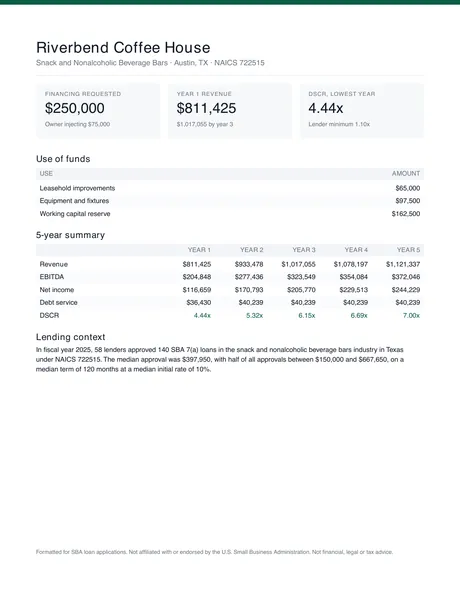
In fiscal year 2025, 101 lenders approved 298 SBA 7(a) loans in the full-service restaurants industry in Texas under NAICS 722511. The median approval was $455,500, with half of all approvals between $150,000 and $999,175, on a median term of 120 months at a median initial rate of 10%.
The Huntington National BankNortheast BankNewtek Bank, National AssociationReadycap Lending, LLCPCB Bank

Nobody else does this. It costs us nothing — the data is public. It changes the conversation you walk into.

03

The one ratio your banker checks first

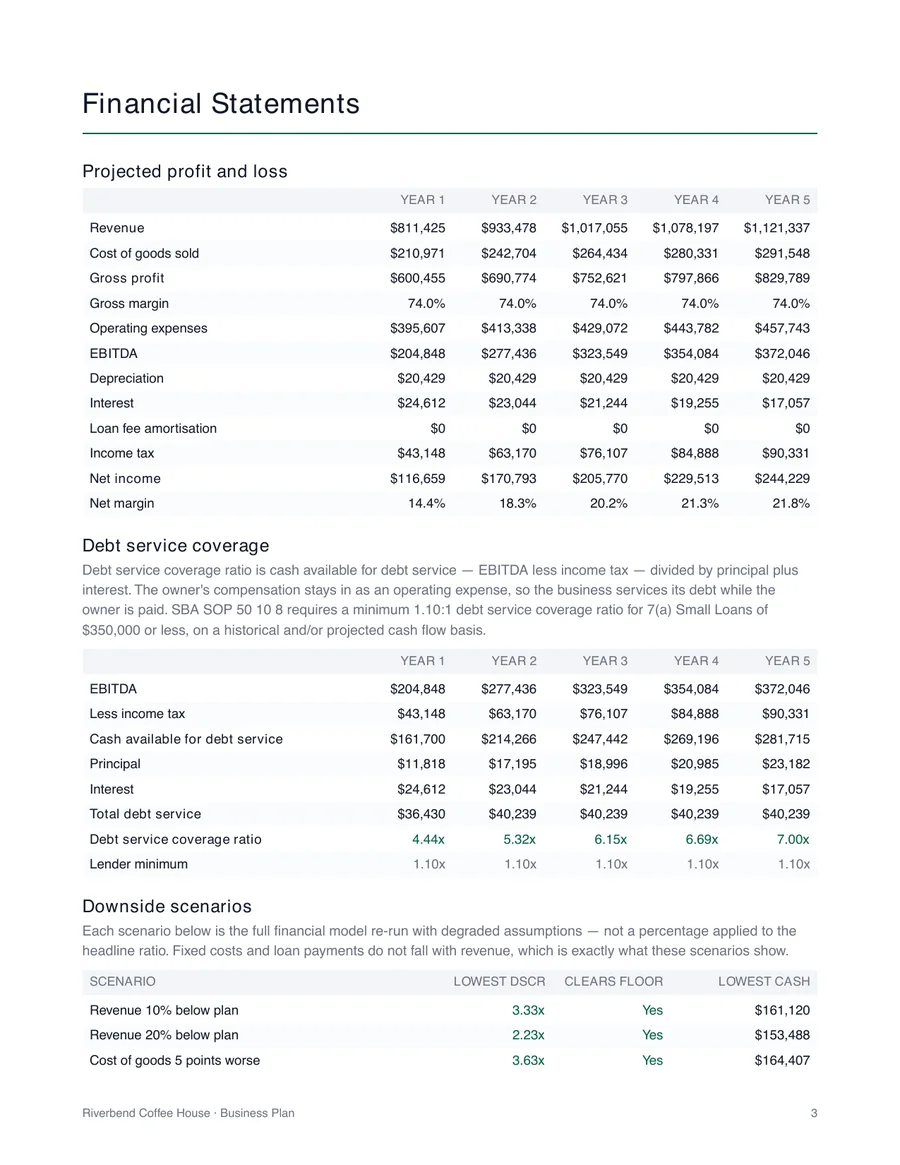
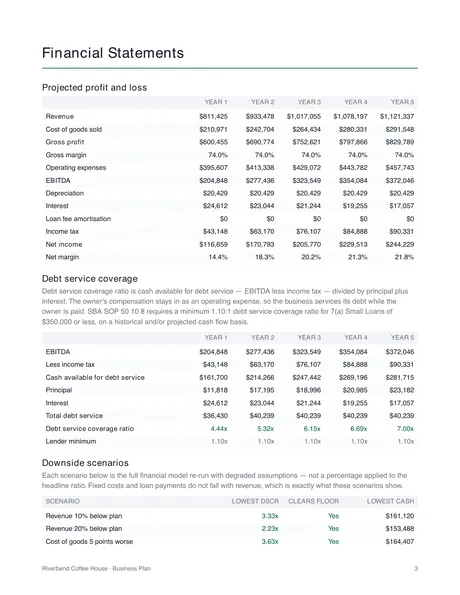
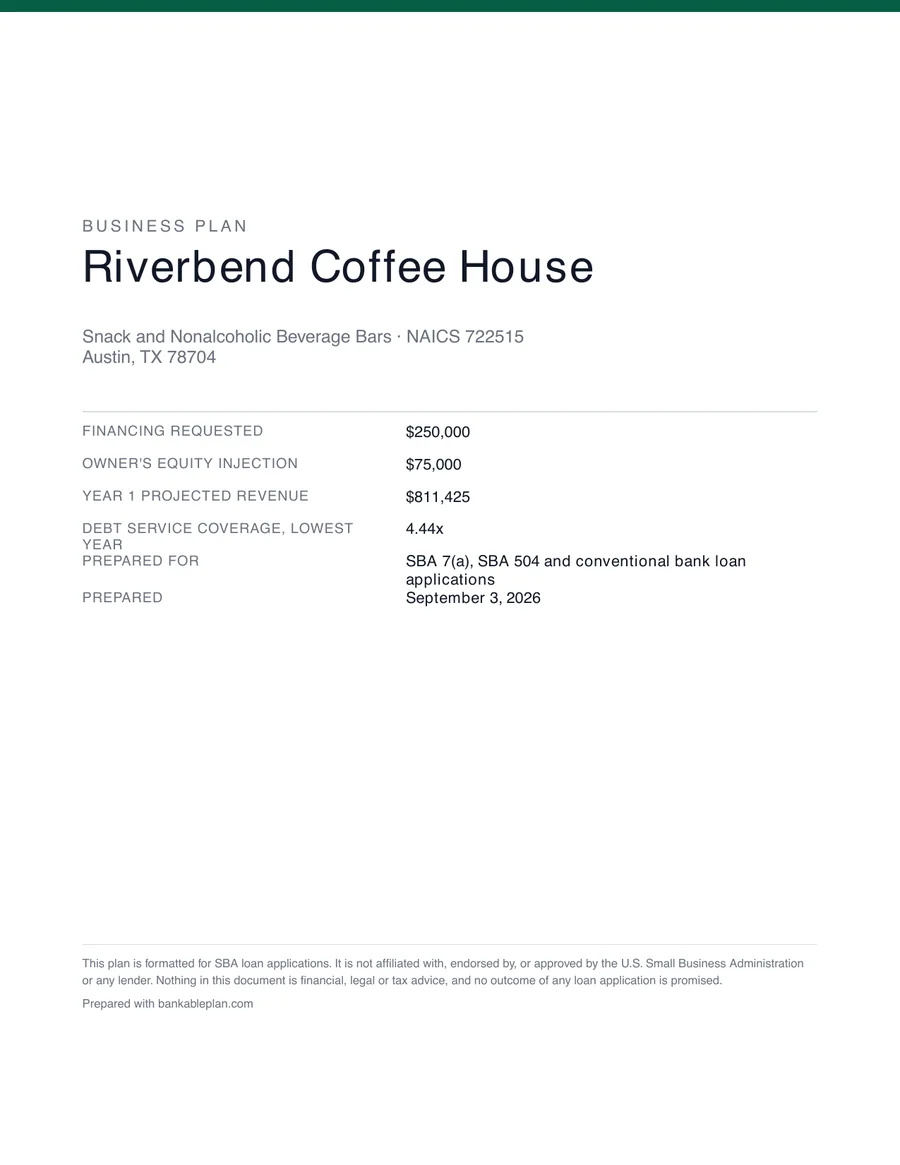
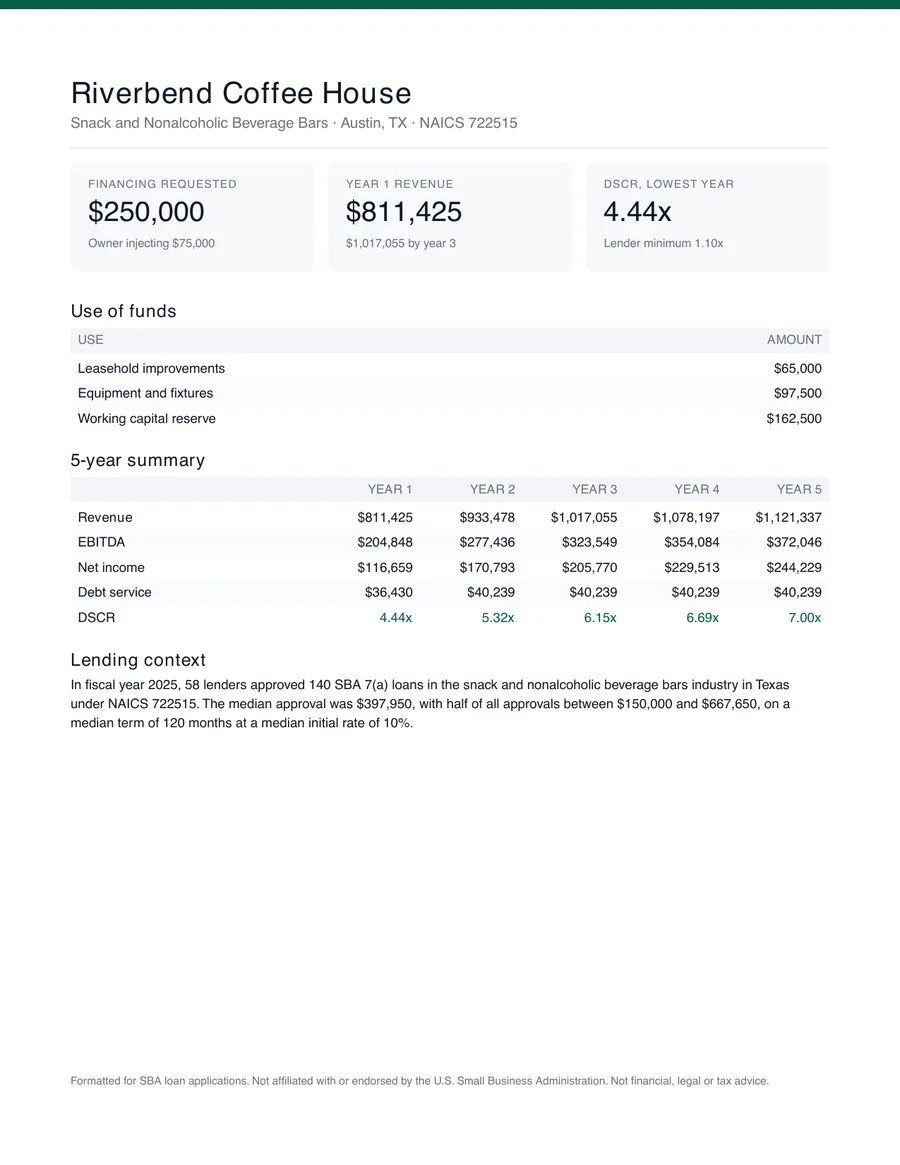
Debt service coverage. Your cash flow divided by your loan payments. Most SBA lenders decline below 1.15×. We compute it, print it on the first page, and — this is the part that matters — tell you before you buy if your plan doesn't clear it, and which lever to move.

Clears the floor
1.42×

Ship it.

Short by $18,400
0.94×

You hear it from us, not from your banker.

What lands in your inbox

Four files. Nine sections. One model that recalculates.

plan.pdf

The complete plan, laid out

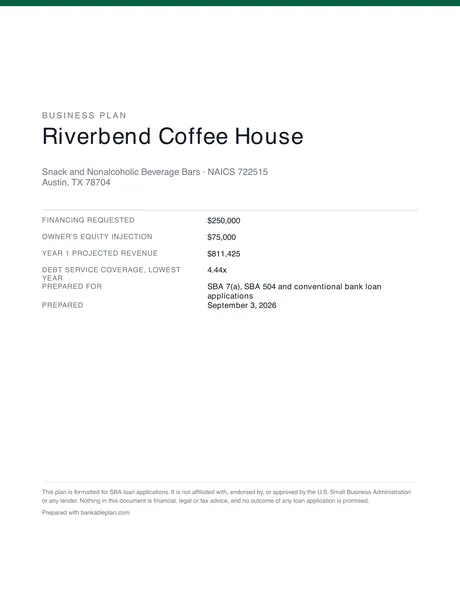
This is what you hand over

plan.docx

The same plan, editable

Your accountant will want to touch it

financials.xlsx

The model, with live formulas

Your lender wants the model, not a picture of one

one-pager.pdf

One-page executive summary

Asked for at every first meeting

The nine sections, in the order a loan package expects them
  1. 01Executive Summary
  2. 02Company Description
  3. 03Market Analysis — the real local data goes here
  4. 04Organization and Management
  5. 05Products and Services
  6. 06Marketing and Sales Strategy
  7. 07Funding Request — amount, use of funds, repayment
  8. 08Financial Projections — P&L, monthly cash flow, balance sheet, break-even, DSCR
  9. 09Appendix — what to attach, and every data source named

Three steps. Ten minutes.

1

Tell us about the business

Five short screens. Industry, ZIP code, what you're asking for, how you make money, and who you are. About four minutes.

2

Read your market analysis, free

We pull your county's real establishment counts and the SBA lenders active in your industry, run the financial model, and show you the executive summary and market analysis. No card, no paywall.

3

Pay only if it's good

$299 unlocks the full nine-section plan and all four files. If the model says your DSCR doesn't clear 1.15×, we tell you that before checkout — not after.

What an E-2 filing needs from the plan

An E-2 filing turns on a small number of specific questions, and the plan is where several of them are answered.

The investment must be substantial and at risk

Not a bank balance. Committed, irrevocable, and spent or contractually obligated. The sources and uses table has to show where the money came from and exactly what it buys — equipment, build-out, inventory, working capital — with the amounts adding up to the total.

The enterprise must not be marginal

This is the part that fails most often. A business that produces only enough income to support the investor and their family is marginal, and marginal is a refusal. The projections have to show income above that threshold, or a capacity to hire, within roughly five years.

That is an arithmetic question, and arithmetic is what a deterministic model is for. Ours produces the profit and loss, the monthly cash flow, the balance sheet and the staffing schedule from one consistent set of assumptions, each of them bounded by published industry ranges.

Jobs, on a schedule

The E-2 / EB-5 version of the plan adds a five-year staffing plan with headcount by role and by year, priced at the real local wage from Bureau of Labor Statistics data for your county — not a national average.

One thing this is not

This is not legal advice, and it does not replace an immigration attorney. Attorneys generally want the plan to exist before they file; several of the numbers in it are ones only a model can produce.
Pricing

One payment. No subscription.

A consultant charges $500 to $3,000 for an SBA-ready plan and takes two weeks. An immigration consultant charges $2,000 to $5,000 for the E-2 version.

Everything included

Complete loan-ready plan

$299one time
  • All nine sections, written around your real numbers
  • Census establishment counts for your county
  • The SBA lenders active in your industry and state, named
  • Three-year model: P&L, monthly cash flow, balance sheet, break-even
  • DSCR computed and printed, with a warning if it falls short
  • PDF, Word, one-pager, and a live Excel model with formulas
Start — see your preview free

You see your market analysis before you pay a cent. Refund policy.

+ $99 revision pack

Three regenerations within 30 days. Your banker asks for a change — you make it.

+ $199 E-2 / EB-5 version

The extra sections a visa filing needs: job creation, source of funds, five-year staffing.

Questions people actually ask

Is this an SBA-approved plan?

No — and be careful with anyone who says otherwise. The SBA is a federal agency; it does not approve or endorse business plan providers. What we do is format the plan the way SBA loan applications expect, in the section order underwriters read, with the ratios they check. Whether a loan is approved is your lender's decision, and nothing here promises an outcome.

Where does the market data actually come from?

Census County Business Patterns for establishment counts and payroll by industry and county. Census Population Estimates and Small Area Income and Poverty Estimates for population and median household income. SBA FOIA data — every approved 7(a) and 504 loan — for lender activity, approval amounts, terms and rates. Bureau of Labor Statistics QCEW for local wages. Every figure in your plan names its source, so your lender can check it.

Does an AI make up the financial projections?

No. That is the whole design. A deterministic engine written in TypeScript does every calculation — profit and loss, monthly cash flow, balance sheet, amortisation, taxes, break-even, DSCR. The language model only proposes operating assumptions such as seasonality, and every assumption it proposes is clamped to published industry ranges before the engine sees it. Then the written sections are checked against the computed figures: any number that does not appear in the model is rejected and the section is rewritten.

What if my plan doesn't clear the 1.15× coverage ratio?

You will see it before you pay, along with the size of the gap and which lever closes it — more revenue, lower operating cost, a bigger equity injection so you borrow less, or a longer term. We would rather lose the sale than sell you a plan that gets declined.

Is the Excel model really live, or just numbers pasted into a grid?

Live. Every cell below the assumptions sheet is a formula. Change the average ticket or the interest rate and the profit and loss, the cash flow, the balance sheet and the DSCR all recalculate. There is a balance check row that must read zero in all 36 months — including after you edit it.

How long does it take?

About four minutes to fill in the form, a minute or two to generate. You get the files immediately after checkout.

Can I use it for an E-2 or EB-5 visa filing?

The base plan covers the business case. The E-2 / EB-5 add-on includes the extra sections those filings require — job creation projections, source of funds narrative, and a five-year staffing plan. It is not legal advice and does not replace an immigration attorney.

Does the E-2 version include the job creation schedule?

Yes. The add-on covers a five-year staffing plan with headcount by role and year, a source-of-funds narrative, and an expanded investment breakdown. The base plan covers the business case and the three-year model.

Is this enough on its own for a consular interview?

No — it is one document in a filing. You will still need your attorney, the investment evidence, the corporate documents and the treaty-country evidence. The plan carries the business case and the numbers.

Marginality is decided by arithmetic.

Make sure it balances, covers its debt, and cites numbers they can check.

Start my plan — free preview

$299 one time, only after you've seen your own market analysis.